Account types and when to use each one
Two rules. Your budget decides the account tier, not the other way round. And cheap accounts are consumables while expensive ones are assets. Unsure? Start with an aged account, a BM3 and an aged Page.
Blank, aged, once-cleared, twice-cleared, cloned, ad account. Plenty of names, but only two rules for choosing.
Conclusion first, explanation after:
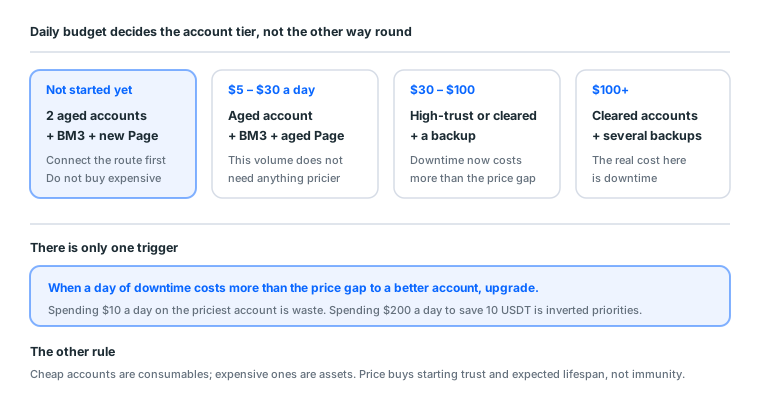
Rule one: your budget decides the account tier, not the other way round. Rule two: cheap accounts are consumables; expensive ones are assets.
1. The glossary
| Name | In plain terms | Rough price band | Purpose |
|---|---|---|---|
| Blank / new | Just registered, no history | Very low | Disposable, testing, filler |
| Aged / durable | Registered 2+ years with basic activity | Low to medium | Main use, opening ad accounts |
| High-trust aged | Aged plus friend count plus post history | Medium | When approval rate matters |
| Once-cleared | Restricted once, since released | Medium | Proven to pass an appeal |
| Twice-cleared | Released twice or more | Medium to high | Most resilient, and most expensive |
| Cloned | Batch-generated from existing data | Very low | Organic reach, volume |
| Ad account product | An account with an ad account already opened | Medium to high | Skipping account creation |
| Page | A Facebook Page, not a personal account | Low to medium | Mandatory for advertising |
| BM | A Business Manager account | Low to high | Managing ad accounts and assets |
What our catalogue actually charges
Those are the general terms; here are the real numbers. The catalogue currently has 145 display groups, 36 of them Facebook:
| Type | Groups | Price band (USDT) | Median |
|---|---|---|---|
| Personal account | 15 | 4 – 50 | 10 |
| Aged account | 5 | 4 – 20 | 13 |
| Page | 4 | 8 – 80 | 80 |
| Self-registered | 4 | 4 – 8 | 4 |
| Cloned | 3 | 4 – 10 | 8 |
| BM | 2 | 10 | 10 |
| Ad account | 2 | 4 | 4 |
Two observations you can act on.
First, the "personal account" band runs 4 to 50 USDT, a spread of more than ten times. Those two words cover both a three-day-old blank and an account cleared twice. Ask about registration year and clearance history rather than trusting the word "aged".
Second, the Page median of 80 USDT is twenty times the ad account median. Market pricing reflects scarcity: you can open an ad account yourself, but a Page's trust accrues through real history, and time cannot be bought.
Price differences between platforms
| Platform | Groups | Price band (USDT) | Median |
|---|---|---|---|
| 67 | 2 – 200 | 13 | |
| 36 | 3 – 80 | 8 | |
| Threads | 18 | 4 – 85 | 10 |
| TikTok | 9 | 2 – 130 | 6 |
Instagram has the most items and the widest band. That reflects organic demand: an Instagram account's value is reach, reach quality varies enormously, and so prices run from 2 to 200 USDT.
2. What once-cleared and twice-cleared mean
An account restricted by the platform and restored through appeal is called "cleared". Once through is once-cleared, twice is twice-cleared.
Why they cost more: they have already been reviewed by a human or a system and passed, which amounts to carrying a record saying "this account is real". In practice their resilience genuinely beats an ordinary account of the same age.
But note: a clearance record is not immunity. An account that has been restricted usually sits at a lower threshold, so doing the same thing may get it restricted again faster than an ordinary account. Cleared accounts suit people who operate carefully but need a high approval rate. They are not test consumables.
An analogy
Think of credit history:
| Blank | Aged | Cleared | |
|---|---|---|---|
| Analogy | Somebody with no credit file | Somebody with a normal record | Somebody with a settled default |
| Starting trust | Low | Medium | Medium-high |
| Tolerance after a problem | Medium | Medium | Low |
The last row is the point. A cleared account starts with higher trust, but once something goes wrong again its tolerance is lower than an account that never had a problem. Which is why it does not suit consumable use: you do not take something already on record and do risky things with it.
3. What budget calls for what
| Your daily budget | Suggestion | Reason |
|---|---|---|
| Not started yet | 2 aged accounts + BM3 + new Page | Connect the route first, do not buy expensive |
| $5–30 a day | Aged account + BM3 + aged Page | This volume does not need cleared accounts |
| $30–100 a day | High-trust or once-cleared + BM50 + aged Page | Downtime now costs more than the price gap |
| $100+ a day | Cleared accounts + BM50 or above + several backups | The real cost here is downtime |
The trigger is simple: when a day of downtime costs more than the price gap to a better account, upgrade.
Turn the trigger into numbers
At ROAS 2, a day of downtime costs roughly twice your daily budget:
| Daily budget | Cost of a day down | Aged → cleared price gap | Worth upgrading |
|---|---|---|---|
| $10 | $20 | About 7 USDT | 🟡 Marginal |
| $30 | $60 | About 7 USDT | ✅ Yes |
| $100 | $200 | About 7 USDT | ✅ Clearly |
| $300 | $600 | About 7 USDT | ✅ No question |
So every tier should upgrade? Not quite, because this table assumes upgrading actually reduces downtime.
In practice, if your downtime comes from no environment isolation or scaling too fast, a pricier account reduces nothing. What needs spending then is not money but effort on environment and rhythm.
When upgrading is a waste
Three situations where an expensive account means nothing:
- You are still verifying the route works. A first ad is for verification, not revenue. Use the cheapest combination
- Your downtime comes from operation rather than account quality. High replacement frequency means checking environment isolation first
- Your daily budget is still small. Losing $20 to a day down does not justify paying tens of dollars more to reduce it
4. Why a Page is mandatory
Meta ads must publish as a Page. Hard requirement, not an upsell. This is where beginners most often stall, and while stalled they usually cannot tell where they are stuck.
Four more reasons:
- Do not advertise from your own brand Page. If the ad account gets into trouble, the linked Page goes into the same records.
- A new Page has no trust. Older Pages with post history clear review noticeably more often, and their cold-start CPM is friendlier.
- One Page per ad account. A reported Page then does not drag other assets down with it.
- A rename-included Page can be reused for another brand, so one investment amortises across several uses.
The differences between four Page tiers
Our catalogue has 4 Page groups, priced 8 to 80 USDT. Functionally identical; three things differ:
| New Page | Aged Page | 1k-follower Page | 10k high-trust Page | |
|---|---|---|---|---|
| Created | Just now | Usually 1+ year | 1+ year | Longer |
| Followers | 0 | Some | 1,000+ | 10,000+ |
| Post history | None | Yes | Yes | Yes |
| User trust | Low | Medium | High | Very high |
| Cold-start CPM | Higher | Medium | Lower | Lowest |
| Suits | Just needing an identity | General runs | When approval rate matters | High-budget long-term |
The price gap is not about features. It is about trust. And the effect of trust multiplies across your entire spend: 10% lower CPM makes every dollar 10% cheaper.
When a more expensive Page pays for itself
Same arithmetic:
| Daily budget | Monthly spend | 1k Page premium | Monthly saving at 10% lower CPM |
|---|---|---|---|
| $10 | $300 | About 70 USDT | $30 |
| $30 | $900 | About 70 USDT | $90 |
| $100 | $3,000 | About 70 USDT | $300 |
Above about $30 a day, the 1k-follower Page premium usually pays back in the first month.
This differs from account logic: you buy a better account to reduce downtime, and you buy a better Page to reduce cost directly. The second is the more certain return.
5. The organic line is a completely different thing
The Instagram and Threads line runs on different logic from ad accounts:
- An ad account is a cost, whose purpose is spending money
- An organic account is an asset, whose purpose is accumulating reach
The two lines compared
| Advertising line | Organic line | |
|---|---|---|
| Platform | Instagram / Threads | |
| The account's role | A tool for spending | An asset accumulating reach |
| Cost of it dying | Get another and continue | The followers are gone |
| What you care about | Whether it can open an ad account | Displayed location, follower quality |
| Needs a Page | ✅ Required | ❌ No |
| Needs a BM | 🟡 With multiple accounts | ❌ No |
| Needs a payment method | ✅ | ❌ |
| Difficulty | High (all five layers must be right) | Low (one account and you start) |
The organic line's biggest advantage is the low barrier. No BM, no Page, no card, no ad review. The downside is that it is slow, and reach is not something you can buy.
How to choose an organic account
What matters is the location shown in the account's profile, because that directly affects which region recommendation traffic goes to.
| Standard | Premium | |
|---|---|---|
| Registration IP | The target region | The target region |
| Profile display | Not necessarily | Shows the region |
| Recommendation traffic | Mixed | Concentrated in the target region |
An account registered on a local IP whose profile also displays that region performs very differently from one merely logged in from that region. That is why the premium version is worth the few extra dollars.
When to take the organic line
| Your situation | Suggestion |
|---|---|
| Budget available, need speed | Advertising line |
| No budget, have time | Organic line |
| Your category is restricted by ad policy | Organic line |
| Building a brand long-term | Both |
The third deserves a mention. Some categories are very hard to clear under ad policy, and forcing it produces repeated rejections, declining account quality, and eventually a disabled account. Organic is the more practical route there.
5b. What each type is actually for
Classification above; "when you genuinely need it" here.
Blank and self-registered
When: you want to test a high-risk creative and expect rejection or worse.
How: as a consumable. The ceiling is "I do not care if this one dies".
Do not: attach a real payment method, spend time warming it, or expect it to survive a first scaling step.
A concrete case: you want to know whether a piece of copy clears review. Submit it on a blank account first, and only take it to your main account once it passes. That keeps your main account's rejection rate clean.
Aged accounts
When: this is your main. At $5 to $30 a day, this tier is enough.
How: as an asset. Seven days of warming up, scaling along the curve, environment isolation done properly.
How to judge one: registration year, basic activity traces (friends, posts), and no restriction banners. An old registration date with no activity at all does not necessarily carry more trust.
High-trust aged accounts
When: your approval rate is poor and you are confident the creative itself is fine.
How: dedicate it to the creative that tends to get rejected. Its advantages are approval rate and cold-start CPM.
Note: if your creative is genuinely crossing a line, a high-trust account gets rejected too. This tier rescues "good creative repeatedly misjudged", not "bad creative".
Once and twice cleared
When: past $100 a day, where downtime costs enough that you want the most stable option.
How: as a long-term asset. Operate it more conservatively than an ordinary account, because its tolerance is lower.
Do not: test creative on it, or run high-risk categories through it. What you bought is stability, not durability.
Cloned accounts
When: organic volume, or bulk accounts for non-advertising purposes.
Not for: advertising. Cloned accounts have no real history, opening an ad account usually stalls, and even when it opens it does not last.
Ad account products
When: your own ad account creation keeps failing, or you want to skip the step.
Watch for: the ad account may already have history, so check the Account Quality page during acceptance. An account with existing violation records sits at a lower threshold than a clean one.
Versus opening your own:
| Buying an ad account product | Opening your own | |
|---|---|---|
| Time | Usable immediately | Seven days of warming up first |
| Account history | Uncertain, must be checked | Clean |
| Time zone and currency | Chosen by somebody else | Chosen by you |
| Price | Higher | The price of an aged account |
"Time zone and currency chosen by somebody else" is the most overlooked. If the ad account you bought is set to UTC and USD while you need your local zone and currency, neither can be changed.
6. Four myths that cost money
"Expensive accounts do not get banned." Price buys starting trust and expected lifespan, not immunity. A twice-cleared account operated the same way may die faster, because an account that has been restricted sits at a lower threshold.
"Cheap accounts are all rubbish." Cheap accounts have their uses: testing creative, verifying a route, filling volume. The problem is not the price. It is treating them as assets. As consumables they are fine.
"Buying from one seller is safer." Safety has little to do with the seller and a great deal to do with your environment isolation and operating rhythm. The same account in different hands can last several times longer.
"Buy more to spread risk." Count is not diversification. Five accounts in one browser profile means one failure reaches all of them. What you diversify is the environment, not the quantity.
7. How to tell you bought wrong
Three signals:
| Signal | Means | What to do |
|---|---|---|
| Bought something unused (a BM50 with one slot used) | Over-specified | Choose by budget next time |
| Replacing accounts every month | Not an account problem | Check environment and rhythm |
| Bought, then found another layer missing | Did not confirm which layer first | See what is an ad account |
The second is the most common and the most expensive. People replacing accounts monthly usually assume the accounts are not good enough, when the actual cause is no environment isolation or scaling too fast.
Check yourself with a number
Asset cost share = monthly replacement cost ÷ monthly ad spend
At the 10 USDT median:
| Daily budget | Monthly spend | 2 per month | 2 per week |
|---|---|---|---|
| $10 | $300 | 6.7% | 26.7% |
| $30 | $900 | 2.2% | 8.9% |
| $100 | $3,000 | 0.7% | 2.7% |
Above 10% means the operating model has a problem, which a pricier account does not fix.
8. Quick glossary
| Term | Which layer | In one line |
|---|---|---|
| Blank / new | Personal account | Just registered, no history |
| Self-registered | Personal account | Batch-produced new accounts |
| Aged / durable | Personal account | Two years plus, with usage traces |
| High-trust aged | Personal account | Aged plus friends and post history |
| Once / twice cleared | Personal account | Restricted then released once or twice |
| Cloned | Personal account | Batch-generated from existing data |
| Ad account product | Personal account plus ad account | An account with the ad account opened |
| Shared account | Ad account | Somebody granting you access to theirs |
| Page | Page | The identity ads publish under |
| BM3 / BM50 | BM | How many ad accounts it holds |
| Premium (organic) | Organic account | The profile displays the target region |
8b. A year of real cost across three operating standards
Everything above, combined. Assume 30 USDT a day in all three (900 USDT a month), differing only in replacement frequency:
| No isolation | Typical | Environment and rhythm both right | |
|---|---|---|---|
| Accounts replaced monthly | 8 | 2 | 0.5 |
| Monthly asset cost (10 USDT median) | 80 USDT | 20 USDT | 5 USDT |
| Annual asset cost | 960 USDT | 240 USDT | 60 USDT |
| Asset cost share | 8.9% | 2.2% | 0.6% |
Left and right differ by 900 USDT, and the gap is not closed by buying better accounts.
Two costs not counted above
Downtime. Every replacement carries a gap: seven days warming up, three days of learning. At ROAS 2 that is about ten days of revenue per replacement. Somebody replacing eight a month spends a substantial share of their time down.
Your time. Each replacement means 30 minutes of inspection, ten minutes a day for seven days, and 30 minutes rebuilding ads. About two hours. Eight a month is 16 hours.
Add those two and the left-hand column's real cost is several times its asset cost.
What this concludes
Lowering replacement frequency is the highest-return action in this business. And it comes from three things that cost nothing:
- Environment isolation (one browser profile per account)
- Scaling rhythm (never above 50%, 48 hours apart)
- Creative that stops crossing policy lines
The first two are fully covered in preparation before buying and the gradual scaling curve.
9. Three questions before buying
Answer these three and you will not buy wrong:
① Which layer am I missing? Personal account, BM, Page, ad account. Four different things, and you buy whichever is missing.
② What is my daily budget? That decides the tier. At $5 to $30 an aged account is enough; do not pay more because "cleared accounts are supposedly better".
③ How many accounts did I replace last month? More than two means checking environment isolation and scaling rhythm first, which beats buying pricier accounts.
9b. What to do if you bought wrong
Not the end of the world, and the fix depends on how you got it wrong.
Three ways, three fixes
① Bought over-specified (a BM50 with one slot used)
Fix: none; that money is spent. But it does no harm. A BM50 just has 47 idle slots.
The lesson: choose by daily budget, not by what sounds better.
② Bought under-specified and outgrew it (a blank account as your main)
Fix: stop investing in that one and switch to the right tier. The warming-up time is gone, but continuing costs more.
The trigger: if that account has already died once or been checkpointed once, switch immediately. Its tolerance has already dropped.
③ Bought but a different layer is missing (three aged accounts and no Page)
Fix: buy the missing layer. Nothing already bought is wasted.
The most common and the most fixable. A Page's median is 80 USDT, and one makes all three aged accounts usable.
One practical suggestion
For a first purchase, take a bundle rather than buying separately.
Not because bundles are cheaper (9.8% to 21.0%, which is not much), but because a bundle already solves "which layer am I missing". That is the classic first-purchase mistake, and it renders everything you bought first unusable.
| Bundle | Bundle price | Parts total | Discount |
|---|---|---|---|
| First run | 39 USDT | 48 USDT | 18.8% |
| Account died again | 49 USDT | 62 USDT | 21.0% |
| Local market | 89 USDT | 108 USDT | 17.6% |
| Steady running | 129 USDT | 143 USDT | 9.8% |
Once you have run a full cycle and know what you use, buying separately saves more.
In one sentence
Unsure? Start with an aged account, a BM3 and an aged Page. That combination handles nine situations out of ten and is cheap enough that losing it does not hurt. Once you know where you get stuck, upgrade that specific thing.
At our catalogue's median prices that is roughly 33 USDT, or the first-run bundle at 39 USDT against 48 separately, saving 18.8% with a more complete set.
Next: BM3 vs BM50 vs BM250.
Sources (all official pages, checked 2026-09-08). Prices, catalogue distributions and warranty ratios in this article are our own catalogue and ticket data, not taken from these pages:
- Create and manage a business portfolio (Business Manager) — Meta Business Help Centre — facebook.com
- Ads Manager — Meta for Business — facebook.com
- Advertising Standards — Meta Transparency Center — transparency.meta.com
- About the Instagram verified badge — Instagram Help Centre — help.instagram.com
FAQ
What do once-cleared and twice-cleared mean?
An account restricted by the platform and restored through appeal. Once through is once-cleared, twice is twice-cleared. Their resilience is genuinely better, but it is not immunity; a previously restricted account usually sits at a lower threshold.
What budget calls for what account?
$5 to $30 a day means an aged account plus a BM3. $30 to $100 starts justifying high-trust or cleared accounts. Above $100 the real cost is downtime, which is when twice-cleared becomes worth it.
Why do bundles always include a Page?
Meta ads must publish as a Page. It is a hard requirement, not an upsell, and it is where beginners most often stall without realising it.
What is the difference between blank and aged accounts?
Registration year and usage history. A blank account has neither history nor trust and its mortality is high. An aged account has a noticeably longer expected lifespan.
Can I advertise from a cloned account?
Not recommended. Cloned accounts are batch-generated from existing data with no real history, and opening an ad account usually stalls. They suit organic reach instead.
Are self-registered accounts the same as blanks?
Broadly yes; both are new with no history. Self-registered are usually batch-produced, cheapest, and suit consumable use.
How old does an aged account need to be?
Two years or more in practice, with basic usage traces. An old registration date with no activity at all does not necessarily carry more trust.
Are expensive accounts really harder to ban?
Their expected lifespan is longer, but they are not immune. Operated the same way, an expensive account still dies, and cleared accounts usually sit at a lower threshold than ordinary ones.
How many should I buy at once?
One, the first time, to walk the route. Once you have volume, keep one half-warmed spare on hand at all times.
What is the difference between an ad account product and an aged account?
An ad account product already has the ad account opened, saving you that step. With an aged account you open it yourself, but you also know that ad account's history is clean.
Why does a Page cost more than an account?
A Page's trust accrues through real post history and followers, and time cannot be bought. Our catalogue's Page median is 80 USDT, twenty times the ad account median.
Can Instagram and Facebook accounts be used interchangeably?
No, they are different products. An Instagram account's value is organic reach; a Facebook account's value is whether it can open an ad account.
Do I pick organic accounts the same way as ad accounts?
Completely differently. An ad account is a cost whose purpose is spending money. An organic account is an asset whose purpose is accumulating reach.
My cheap accounts keep dying, what now?
Check environment isolation and scaling rhythm first. High replacement frequency usually comes from those two, and a pricier account will not fix them.
When should I upgrade the account tier?
When a day of downtime costs more than the price gap to a better account. That number is calculable rather than a feeling.
Want the parts this article talks about?
See the catalogRead next
Running Facebook Ads: the complete path from nothing to your first live ad
The whole route on one page. From "where is Ads Manager" to "how do I
What is an ad account? How personal accounts, ad accounts, BMs and Pages relate
Four things get talked about interchangeably, but they are four separa
BM3 vs BM50 vs BM250, and how allowances actually work
That number is not how much you can spend. It is how many ad accounts
Six things to know before buying a Facebook account
This market runs on serious information asymmetry. Here are the questi