The gradual scaling curve from day eight
After the seven-day warm-up, never raise budget by more than 50% at a time and leave at least 48 hours between increases. Going straight to full budget is the fastest way to turn a healthy account into a dead one, because "never spent, now spending a lot" has the same shape as a stolen card in billing-risk terms.
Budget is not whatever you feel like setting. Scale too fast and the system treats your account as a disposable one.
The biggest temptation after seven days of warming up is setting the full budget at once. That is the fastest way to turn a healthy account into a dead one.
1. Why you cannot go straight to full budget
Ad systems apply a very intuitive test to new accounts: an account that has never spent suddenly wanting to spend $500 a day has, in billing-risk terms, the same shape as a stolen card. The system does not need to decide whether you are a good person. It only needs to decide whether the money is collectable.
So the correct approach is proving you can pay and did pay, then climbing gradually.
Two independent mechanisms at work
People treat "scaling too fast gets you banned" as one vague statement. It is actually two separate mechanisms:
| Mechanism | What it guards against | The rule |
|---|---|---|
| Billing-risk determination | The payment method may not be yours | Never above 50% |
| The learning phase | The system has not learned who to target | At least 48 hours apart |
Follow both, because they guard against different things.
Follow the percentage without the interval and you avoid the billing flag, but learning never finishes and cost never comes down. Follow the interval without the percentage and learning completes, but you trip risk controls.
Why 50%
Not an officially published threshold. A line drawn from practice.
The logic behind it: a gradually rising spend curve looks like normal business expansion, and a vertical one looks like somebody got hold of a payment method that is not theirs.
| Increase | Looks like |
|---|---|
| +20% | A routine adjustment |
| +50% | Aggressive expansion, still within reason |
| +100% | Worth noticing |
| +500% | Billing risk |
More conservative is of course safer, such as 20% at a time. The cost is a slower climb, and you may miss your timing. 50% is the balance point between fast enough and still reasonable.
Why 48 hours
That is the minimum time for the learning phase to complete.
Every significant change to an ad set re-enters learning, and the system has to work out who to show the ad to all over again. Changing again before learning finishes means the system probes permanently, and probing costs money.
Forty-eight hours is the minimum for the previous adjustment to accumulate enough data to judge. With less data, the cost variation you see is noise rather than signal.
2. The suggested curve
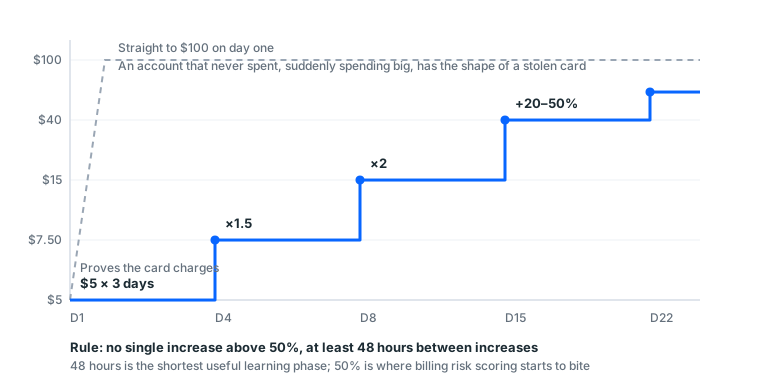
| Period | Daily budget | Purpose |
|---|---|---|
| D8–D10 | Minimum viable (say $5/day) | Prove the charge works, confirm creative passes |
| D11–D14 | Previous × 1.5 | Build payment history |
| D15–D21 | Previous × 1.5–2 | Start getting meaningful volume |
| D22 onward | +20–50% each time, at least 48 hours apart | Normal scaling |
One sentence: never increase by more than 50%, and leave at least two days between increases.
Walk it with real numbers
Starting at $5, raising 50% every two days:
| Day | Daily budget | Cumulative |
|---|---|---|
| D8–D10 | $5 | $15 |
| D11–D12 | $7.50 | $30 |
| D13–D14 | $11 | $52 |
| D15–D16 | $17 | $86 |
| D17–D18 | $25 | $136 |
| D19–D20 | $38 | $212 |
| D21–D22 | $57 | $326 |
Two weeks in you are at $57 a day with no single jump anywhere. Faster than most people assume.
"Following the curve is slow" is a misconception. What is genuinely slow is getting stopped and starting over, which means seven days of warming up and climbing again from the bottom.
If you start from a higher base
Not everybody starts at $5. From a higher base the proportions are identical:
| Starting budget | After two weeks | After a month |
|---|---|---|
| $5 | About $57 | About $190 |
| $10 | About $114 | About $380 |
| $20 | About $228 | About $760 |
The rule is proportional, not absolute. Going from $20 to $30 (+50%) is the same act as going from $100 to $150 (+50%).
3. Other things that also need to go slowly
Creative
Do not upload ten new creative sets in one day. New accounts get stricter review, and a batch of rejections leaves an ugly rejection rate on the account.
One or two at a time, adding more once they pass.
Audience
Do not start with a very narrow audience or a very broad region. Start with a mid-sized audience you genuinely understand.
Practical floor: keep the audience size estimate above 500,000. Smaller and the learning phase never finishes.
Payment method
Do not change cards once you have volume. Changing a payment method is an account-level change, and doing it while actively spending means touching the most sensitive thing at the most sensitive moment. Change it during a low-budget period.
The Page
One ad account, one Page, and do not switch Pages mid-flight. If you must, lower the budget first, switch, observe for two days, then climb back.
One variable at a time
The principle running through all four:
| What you want | Wrong | Right |
|---|---|---|
| Raise budget and change creative | Same day | Raise first, change creative once stable |
| Change audience and placements | Same day | Two separate changes, 48 hours apart |
| Raise budget and switch Pages | Same day | Lower budget, switch Page, observe two days, climb back |
Move two variables together and you will not know which produced the difference, or which to repeat next time.
4. When to stop
These signals mean stop and do not keep raising:
- Rejection rate suddenly rises (two or three creative sets rejected in a row)
- "Verify your identity" or billing-related prompts appear
- Spend pacing goes strange (budget unchanged but spend surges or drops to zero)
- CPM doubles within a day
Stopping means holding the current budget for 3 to 5 days and changing nothing. Most anomalies pass on their own. Continuing to scale during one is the standard procedure for turning a small problem into a permanent ban.
What each of the four signals means
| Signal | Usually | What to do |
|---|---|---|
| Rejection rate rising | Creative crossing a line, or declining account quality | Check Account Quality, change creative |
| Identity or billing verification prompt | Billing-risk determination triggered | Stop scaling immediately, complete the verification |
| Spend surging | The system probing, or a settings error | Confirm the budget setting, observe three days |
| Spend at zero | Audience too narrow, bid too low, or restricted | Check delivery status and audience size first |
| CPM doubling in a day | The auction environment moved, or account quality dropped | Observe three days, leave creative alone |
The second is the most serious. A billing-related verification prompt means billing-risk determination has already been triggered, and continuing to scale then almost always leads to a zeroed limit or a disabled account.
How to "stop" properly
Stopping is not switching off:
| Approach | Correct | Why |
|---|---|---|
| Hold the current budget, change nothing | ✅ | Let the anomaly pass |
| Lower the budget | 🟡 Acceptable, but it is also a change | If you must, do it in steps |
| Pause entirely | ❌ | Resets learning and breaks the spend record |
| Switch to a new ad account | ❌ | A new account's limit starts from zero |
"Pause entirely" is where most people go wrong. The instinct to switch off and stop the bleeding feels right. What you actually lose is accumulated learning and payment history, and restarting means starting over.
How long to observe
| Severity | Observation period |
|---|---|
| A single creative rejected | No stop needed; fix that one |
| CPM up with no other signs | 3 days |
| Consecutive rejections | 3–5 days, and change creative |
| A verification prompt appeared | 5 more days after completing it |
The observation period ends when the warning signs disappear, not when the clock runs out. Signs still present means keep waiting, rather than raising on day three because the table said three.
5. Actually performing an increase
Rules above; execution here.
Three confirmations before every increase
- Has it been more than 48 hours since the last adjustment
- Has cost per result been stable over the past three days (three days, not one)
- Are there any of the warning signs in §4
All three pass before you raise. Any one failing means waiting.
How much: a simple formula
New budget = current budget × 1.3
Use 1.3 rather than 1.5 to leave headroom. 1.5 is a ceiling, not a target, and there is no benefit to running against it.
Use 1.5 only when cost performance is exceptional and has been stable for over a week.
The 48 hours after an increase
Do nothing. Specifically:
| Allowed | Not allowed |
|---|---|
| Check the three numbers daily | Change the budget |
| Record them | Change the audience |
| Prepare the next creative set (do not upload) | Swap creative |
| Watch for warning signs | Pause and resume |
"Prepare the next creative set but do not upload it" is a genuinely useful habit. You will itch to do something during those 48 hours, and this channels that impulse into preparation rather than into changing settings.
When you can stop following the curve
Three conditions together:
- The account has over a month of stable payment history
- The spending limit has clearly loosened, or is gone entirely
- The cost curve is steady with no large swings
In practice around day 30. After that you still should not double overnight, but you can adjust in larger steps.
5b. The learning phase, fully explained
Mentioned repeatedly above; finished here. Understand it and a lot of "why can I not change this" rules stop being prohibitions.
What it is doing
When an ad set first goes live, the system does not know who inside your audience responds. It shows the ad to a small group, watches who clicks and converts, and adjusts.
That probing costs money, and that money lands in your cost. So high cost during learning is not an anomaly. It is inevitable. The only question is whether it ever ends.
What restarts it
| Action | Restarts it | Severity |
|---|---|---|
| Large budget change (past 50%) | ✅ | High |
| Audience change | ✅ | High |
| Placement change | ✅ | High |
| Optimisation event change | ✅ | High |
| Pausing and resuming | ✅ | High |
| Creative swap | 🟡 Smaller effect | Medium |
| Copy edit | 🟡 Smaller effect | Medium |
| Renaming the ad | ❌ | None |
What "pause and resume" actually costs
Almost nobody knows this one, so it is worth calculating.
Say you switch ads off for two days every weekend. That is four learning restarts a month. If each restart raises cost by 30% for three days:
Affected days per month = 4 × 3 = 12
Share = 12 ÷ 30 = 40%
You spend 40% of the time paying elevated cost, in exchange for two days of budget not spent.
At $30 a day: switching off two days a week saves 8 × 30 = $240 of budget, while those 12 days cost 30% more, which is 12 × 30 × 0.3 = $108 extra, and those two days earned nothing at all.
To save budget, lower it rather than pausing.
Three ways learning never finishes
- Audience too small: daily impressions are limited, so samples accumulate too slowly
- Budget too low: same mechanism
- Changing too often: every change restarts it
The third is the most common among beginners, and it is self-inflicted.
Which explains "change nothing for 48 hours after an increase"
See high cost on day one, change something, learning restarts, cost rises, change again. You stay inside the learning phase permanently, paying the highest possible cost.
Not a discipline problem. An arithmetic one. Every extra change buys another round of the system's probing.
6. Backups: prepare from the start
The biggest difference between experienced and beginner buyers is not operation. It is backup.
- Once one account has volume, start warming the second immediately
- Share the ad account with another Facebook account as admin in advance. A built-in platform feature, used normally. If the original account gets stuck at a checkpoint, you can at least see the ad account's status from the other identity and extract your data
- Page, BM, ad account, personal account: do not stake all of them on one set
Backup is not pessimism. It is baseline equipment in this business. Accounts die without exception, and the only difference is whether you have a second one ready that day.
When to start warming a backup
The day your main account starts getting volume. Not the day something breaks, and not "when I get around to it".
Because warming up takes seven days. Starting on the day something breaks means seven days before delivery resumes, and those seven days earn nothing.
| Your daily budget | Cost of one day down (ROAS 2) | Seven days |
|---|---|---|
| $30 | $60 | $420 |
| $100 | $200 | $1,400 |
A backup aged account's median is 13 USDT. That ratio needs no further explanation.
Backups need to stay active
A backup untouched for three months may already need re-verification. Suggested:
- Log into the backup account monthly and stay five to ten minutes
- Run a tiny budget through the backup ad account monthly (say $1 a day) to keep it active and building payment history
A backup with no upkeep is not a backup, and you find out at the moment you most need it.
6b. Scaling horizontally instead of vertically
One account's budget is not unlimited. This is about when to stop enlarging one account and open another instead.
Vertical versus horizontal
| Vertical scaling | Horizontal scaling | |
|---|---|---|
| Method | Raise budget on one account | Open another account to share load |
| Ceiling | The spending limit | How many accounts you can manage |
| Risk | Concentrated in one account | Spread |
| Management overhead | Low | High |
| Suits | Starting out to mid-volume | Once you have volume |
Three signals to go horizontal
① The spending limit has become the bottleneck. Your daily spend consistently hits the limit and raising budget spends nothing extra. What you need to add is an account, not budget.
② One account carries too much of your revenue. If that account were disabled tomorrow your revenue would go to zero. That exposure is too concentrated.
③ You are running different products or clients. A management need rather than a volume need, with the same conclusion: separate them.
How to scale horizontally properly
A new account climbs the curve from the bottom. The most underestimated point here: limits sit at account level, so a new account starts from zero regardless of how high your existing one reached.
So the correct sequence is:
- Before the main account hits its ceiling, open the second account and start running a small budget
- Let the second account accumulate its own payment history
- When the main account hits its ceiling, the second already has enough limit to take over
Wait until the main account is stuck to open the second and you are climbing from $5 for two weeks.
The practical ceiling on account count
| Your total daily budget | Suggested accounts |
|---|---|
| $5–50 | 1 |
| $50–200 | 2 |
| $200–500 | 3–4 |
| $500+ | As needed, and consider separate BMs |
Do not over-diversify for its own sake. Every account runs its own learning phase and accumulates its own signal, so too many accounts leaves each one short of data.
And past three accounts, management overhead rises noticeably: naming, records, reconciliation and monitoring all multiply by the account count.
7. Four myths that cost money
"A higher budget makes the system try harder." Budget decides what you are willing to spend, not the system's effort. Too high a budget on a new account only trips risk controls.
"Scaling slowly costs me the opportunity." Following the curve takes you from $5 to $57 in two weeks and $190 in a month. What is genuinely slow is getting stopped and starting over: seven days of warming up, then climbing again.
"Switching off at the weekend saves money." Pausing and resuming resets the learning phase. Two days off a week is four resets a month, and those four elevated-cost periods far exceed the budget saved.
"High cost means lower the budget first." Lowering is also a change, and it also affects learning. The correct order when cost is high is CPM first, then CTR, and only then budget. See how Facebook ad costs work.
7b. How the spending limit grows
Your scaling ceiling is the spending limit, so here is how it works.
What it is
The ad account's daily spending ceiling. New accounts have low limits because the platform needs to confirm the money is collectable. Billing-risk assessment, not an opinion about you.
How it loosens
The only way is producing successful charges. No shortcut, and no application process.
| What you do | Effect on the limit |
|---|---|
| Spend steadily every day with successful charges | ✅ Loosens gradually |
| Spend erratically, on and off | 🟡 Loosens slowly |
| Charges fail | ❌ May be lowered |
| Open a new account | ❌ Starts from zero |
The last row deserves emphasis. Plenty of people open a new account when the limit is stuck, but a new account's limit is only lower, and opening a burst of new accounts is itself a risk signal.
Four ways the limit gets stuck
| Symptom | Means | What to do |
|---|---|---|
| A limit exists but is low | Normal new-account state | Follow the curve; it grows |
| The limit shows as 0 | The account is restricted | Read Account Quality |
| Spend stops at a number | You hit the daily limit | Resets tomorrow |
| Payment failing | Card problem | Change card or call the bank |
Distinguish the first from the second. The first needs patience; the second needs the account problem handled. Completely different responses.
How the limit interacts with your curve
If your budget already approaches the limit, raising it achieves nothing, because the extra cannot be spent.
The test: if your daily spend consistently hits the limit, you are waiting for the limit to loosen, not raising budget.
The practical approach: hold your current budget, let payment history keep accumulating, and raise once the limit loosens. Raising in a hurry only makes the budget figure look bigger without spending more.
8. A scaling log you can copy
Record every increase and in three months you have your own curve.
| Date | Action | Old | New | Increase | Since last | Cost per result then | Note |
|---|---|---|---|---|---|---|---|
| 08-08 | Start | – | $5 | – | – | – | D8 |
| 08-11 | Raise | $5 | $7 | 40% | 3 days | $2.50 | Normal |
| 08-13 | Raise | $7 | $9 | 29% | 2 days | $2.27 | Normal |
| 08-15 | Hold | $9 | $9 | 0% | 2 days | $3.07 | CPM up, observing |
| 08-19 | Resume | $9 | $12 | 33% | 4 days | $2.37 | Signs cleared |
The "hold" row is the most valuable. Three months later it tells you at what budget level and under what conditions your accounts tend to show warning signs, which is information no guide can give you.
Three uses for this log
- Deciding whether to raise now: how many days since the last one, and whether cost is stable
- Tracing back when something breaks: what you did in the 48 hours before, in one lookup
- Building your own rhythm: after three accounts you learn what level your accounts tend to wobble at
9. Three scaling situations
Rules above; three situations you will actually face.
One: cost is great and you want to scale fast
The most dangerous situation, because good cost lowers your guard.
You see cost per result well below break-even and the instinct is "raise it while it is still cheap". But billing-risk determination does not care how good your cost is. It only reads the shape of the spend curve.
Correct approach: still × 1.3, still 48 hours apart. Good cost means you can raise repeatedly without stopping, not that you can jump.
A useful framing: treat "cost is good" as "I can raise many times in a row" rather than "I can raise a lot at once". Ten consecutive × 1.3 increases is 13.8×, which is already fast.
Two: cost is right around break-even
Do not raise yet. Raising budget usually pushes cost up slightly (you are buying more impressions), so an ad exactly at break-even goes into loss.
Correct approach: improve cost first. Run the three-step diagnosis (CPM → CTR → landing page), find what can be moved, and start climbing once cost has come down.
Three: cost is poor, and you wonder whether more volume would stabilise it
It would not. The most common and most expensive misconception here.
Volume does not improve unit cost. It only spends your budget faster. Learning-phase cost is high because the system has not learned yet, not because volume is insufficient.
Correct approach: lower budget or stop and diagnose. Do not raise.
What the three share
| Your cost per result | What to do |
|---|---|
| Clearly below break-even | Keep raising along the curve |
| Near break-even | Improve first, do not raise |
| Above break-even | Diagnose, and stop-loss if needed |
Raising budget amplifies your existing result. It does not change its direction. A profitable ad scaled earns more; a losing ad scaled loses more. That sounds obvious, and a great many people do the second one anyway.
10. This guide as one card
Stick it wherever you read your reports:
Before every increase:
  □ At least 48 hours since the last one
  □ Cost stable over the past three days
  □ No warning signs

How much:
  Current budget × 1.3
  (Use 1.5 only when performance is exceptional and stable for over a week)

For 48 hours after:
  Change nothing

Four signals mean stop:
  Rejection rate up / verification prompts / spend anomalies / CPM doubling in a day
  Stop = hold the current budget 3–5 days. Not switching off.

Never:
  Pause and resume at weekends
  Move two variables at once
  Raise budget when cost is poor
Next: how to use a 2FA key, where most people stall, and it takes thirty seconds.
Sources (all official pages, checked 2026-09-08). Prices, catalogue distributions and warranty ratios in this article are our own catalogue and ticket data, not taken from these pages:
- About the learning phase — Meta Business Help Centre — facebook.com
- How the ad auction works — Meta Business Help Centre — facebook.com
- How much it costs to advertise on Meta — Meta Business Help Centre — facebook.com
- Advertising Standards — Meta Transparency Center — transparency.meta.com
- Ad metric field definitions (Marketing API Insights) — Meta for Developers — developers.facebook.com
FAQ
Can I set the full budget straight away?
No. From D8 use the minimum viable budget to prove the charge works, then raise by 20 to 50% at a time with at least two days between.
What signals mean I should stop?
A sudden rise in rejections, identity or billing verification prompts, abnormal spend pacing, or CPM doubling in a day. Stopping means holding the current budget for 3 to 5 days and changing nothing.
How many backups should I prepare?
Once one account has volume, start warming the second immediately, and share the ad account with another Facebook account as admin in advance. It is a built-in collaboration feature.
Why 50% and not 30% or 100%?
50% is the practical threshold for billing-risk determination. More conservative is safer, but climbing too slowly costs you timing. Above 50% clearly raises the chance of being flagged.
Why 48 hours?
That is the minimum time for the learning phase to complete. Changing again before the previous adjustment has accumulated data means the system probes permanently.
Does the 50% rule apply to decreases too?
Lowering carries less risk than raising, but a large decrease resets the learning phase too. If you need to lower, do it in steps.
Can I switch ads off at the weekend?
Not advisable. Pausing and resuming resets the learning phase, and two days off a week is four resets a month. To save budget, lower it rather than pausing.
How long until a budget increase shows an effect?
Settings apply immediately, but results only stabilise once learning completes. So the point is not changing anything again within 48 hours.
Can I raise budget and change creative at the same time?
No. Move two variables together and you will not know which produced the difference.
What if the spending limit is stuck?
First establish whether it is "a new account's normally low limit" or "restricted". The first grows on its own along the curve; the second means checking Account Quality.
When can I stop following the curve?
Once the account has a stable payment record, the spending limit has clearly loosened, and the cost curve is steady. In practice around day 30.
Should I change creative while scaling?
No. Leave creative alone on scaling days so there is only one variable. Change creative during the stable days between increases.
Can I split budget across many ads?
Not in month one. Too many at once compete for the same audience, budget gets divided, and none of them finishes learning.
What if I accidentally raised it too much?
Do not immediately change it back; that is a second change. Hold for three to five days and observe. Lower it to the previous level if warning signs appear, and continue if not.
Does a replacement account have to climb again?
Yes. Limits sit at account level, so a new account starts from zero regardless of how high your previous one reached.
Want the parts this article talks about?
Next: how to use a 2FA keyRead next
Running Facebook Ads: the complete path from nothing to your first live ad
The whole route on one page. From "where is Ads Manager" to "how do I
How Facebook ad costs work: CPM, CPC and ROAS unpacked
Ad cost is not one number. It is a chain of ratios multiplied together
The first seven days: how to warm up an account
There are seven days between "it logs in" and "it can run ads". Skippi
What to do when an account hits a checkpoint
Work out which kind you are looking at first. Some clear once you veri