How Meta policy changes affect account survival
When accounts start dying in batches it is usually not your fault; the rules changed. Diagnose with three questions: is it happening across several unrelated accounts, did you change anything recently, and are other advertisers reporting the same thing.
When accounts start dying in batches, it is usually not something you did. The rules moved. This is how to tell, and how to respond.
Do this long enough and you meet this: nothing changed, and one Tuesday morning three of your accounts are disabled at once. You audit your own work and find nothing.
Because the problem is not your operation. The rules moved.
1. What a policy change looks like
Platform rule adjustments come in a few shapes, with different symptoms:
| Type of change | What you see |
|---|---|
| Review threshold tightened | Creative that always passed starts getting rejected |
| New account limits tightened | New ad accounts get lower spending limits, or will not open at all |
| An industry reclassified | Your whole category suddenly needs extra verification |
| Verification requirements widened | Accounts that never needed verification start being asked |
| An enforcement wave | A batch of accounts disabled the same day, with similar characteristics |
How long each type lasts
Practical experience, not official figures:
| Type of change | Usually lasts | Does it revert |
|---|---|---|
| Review threshold tightened | Days to weeks | Mostly loosens back |
| New account limits tightened | Weeks | Yes, but new accounts start accumulating again |
| Industry reclassified | Permanent | No; that is a policy change |
| Verification widened | Permanent | No, but you can complete the verification |
| Enforcement wave | Days | Accounts caught in it usually do not come back |
The third and fourth are structural; the first three are fluctuations. That distinction matters: fluctuations you ride out, structural changes you adapt to.
Telling a fluctuation from a structural change
| Signal | Fluctuation | Structural |
|---|---|---|
| Did the platform announce it | Usually not | Usually yes |
| Scope | Some accounts | An entire category or region |
| Two weeks later | Starting to loosen | No change |
| Newly opened accounts | Equally affected | Equally affected |
Two weeks is the practical observation period. No improvement at all after two weeks usually means structural, and what needs adjusting is your approach rather than your patience.
2. Rules changed, or did I get it wrong
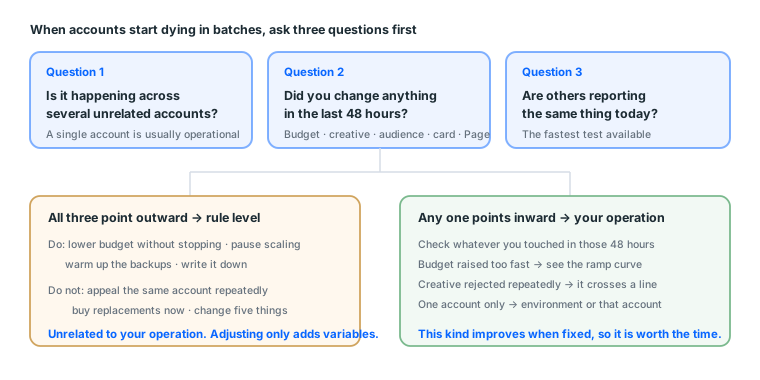
Ask three questions:
Is it happening across several accounts at once? A single account is usually operational. Several unrelated accounts on the same day is external.
Did I change anything recently? Budget, creative, audience, payment method, Page. Anything touched in the 48 hours before is the first suspect.
Are other advertisers seeing the same thing? The fastest test. A lot of people reporting identical symptoms on the same day means it is at rule level.
All three pointing outward means do not rush to adjust your operation. Changing things now only adds variables, and afterwards you cannot tell whether the wave passed or your changes worked.
The order of the three questions is deliberate
Ask "several accounts" first, then "did I change anything", then "are others seeing it".
| Order | Why |
|---|---|
| 1. Several accounts | Fastest; you can answer it yourself |
| 2. Did I change anything | Needs your tracking sheet, but still quick |
| 3. Are others seeing it | Requires asking around; slowest |
If the answer to the first is "only one account", you rarely need the third. A single account failing is nine times out of ten that account's own problem: environment, creative, or scaling.
Why 48 hours in the second question
Because that is the length of the learning phase, and it is the observation window most platform determinations use.
Whatever you touched inside 48 hours has the highest probability of a causal link to the current symptom. Changes older than that would usually have caused problems already.
Which is why a scaling log is useful: when something breaks you can look up what you did in those 48 hours rather than relying on memory.
3. What to do during a rule change
Do
- Lower the budget, do not stop. Stopping entirely breaks the account's spend record and makes climbing back slower. Hold at a minimum viable budget.
- Pause scaling. Raising budget now amplifies exposure at the most uncertain moment.
- Bring backups out and warm them. A rule change is when backups actually earn their keep.
- Write it down. Date, symptom, affected accounts, how it recovered. After three of these you start seeing patterns.
Do not
- Do not change five things at once. You will not know which one worked.
- Do not appeal the same account repeatedly. During an enforcement wave, appeals rarely work.
- Do not immediately buy a pile of replacements. New accounts entering while rules are tight have the highest mortality. Wait a week.
- Do not believe anybody claiming a workaround. Rule changes bring out sellers of supposed bypasses. Anything that genuinely worked would be used rather than sold.
The arithmetic behind "lower, do not stop"
The most counter-intuitive rule here, so it is worth running.
Say your daily budget is 30 USDT and a rule change means riding out two weeks:
| Approach | Two weeks of spend | Time to recover afterwards |
|---|---|---|
| Stop entirely | 0 USDT | Re-warm plus re-run learning, about 10 days |
| Drop to 5 USDT | 70 USDT | Climb straight back along the curve, about 3 days |
Stopping saves 70 USDT and costs seven extra days of recovery.
At ROAS 2, seven days of revenue is roughly 420 USDT. Saving 70 to lose 420 is a clear loss.
And stopping entirely carries two hidden costs: a broken spend record slows the growth of your spending limit, and a reset learning phase makes the first days after recovery more expensive.
What the incident log should contain
| Column | Example |
|---|---|
| Date | 2026-08-12 |
| Symptom | Rejection rate spiked on three accounts the same day |
| Scope | Accounts A, B, C (different BMs) |
| Budget at the time | 30 / 45 / 20 USDT |
| Creative at the time | All the same image set |
| Answers to the three questions | Yes / no changes / others too |
| Outcome | Dropped to 5 USDT, normal again on day 9 |
"Creative at the time" is the crucial column. If all three accounts ran the same creative, this may not be rule level at all; that creative may be crossing a line. Only a record makes that distinction visible.
4. Structural preparation
Policies keep changing, without exception. What you can do is make yourself less afraid of it:
- Do not stake everything on one account, one Page or one BM.
- Keep one or two fully warmed backups, ready to go.
- Separate assets from accounts: audiences, pixel settings, creative and copy all stored outside the account. The account dies and none of that needs rebuilding.
- Share the ad account with a second identity as admin (see what to do at a checkpoint).
- Record every incident. The only asset here that appreciates over time.
What these five have in common
All of them happen in normal times. None can be done on the bad day.
| Item | Time it takes normally | Possible on the day |
|---|---|---|
| Spreading assets | Incidental to buying | ❌ Too late |
| Warming a backup | Seven days | ❌ Too late |
| Storing assets separately | Ten minutes | 🟡 Only if you can still get in |
| Adding a second admin | Two minutes | ❌ Cannot, if you are locked out |
| Recording incidents | Five minutes each | 🟡 But with no history to compare |
The fourth is the clearest. Once the account is stuck you cannot share permissions, because you can no longer get in.
What "separate assets from accounts" actually means
| Asset | Where | Cost of not having it |
|---|---|---|
| Audience settings | Screenshot or text | Guessing all over again |
| Pixel ID | Your tracking sheet | Reinstalling from scratch |
| Creative that performed | Your cloud storage | Remaking it |
| Copy | Same | Same |
| Performance baseline | A spreadsheet | Gone permanently |
The last is the most valuable and the most overlooked. Your CPM range, average CTR and cost per result are numbers you paid to learn, and they live in no account.
5. A more fundamental note
If you find yourself buying new accounts every month, the problem is not account quality. It is the operating model.
High mortality usually traces to one of three things:
- No environment isolation (one profile holding several accounts)
- Scaling too fast (see the gradual scaling curve)
- Creative that keeps crossing policy lines
A more expensive account solves none of the three. With those three solved, cheap accounts last a long time.
Which is why we put the weight on guides rather than warranties: a warranty compensates you, whereas guides mean you never need to claim.
Check yourself with a number
Asset cost share = monthly replacement cost ÷ monthly ad spend
Using our catalogue median of 10 USDT:
| Daily budget | Monthly spend | 2 per month | 2 per week |
|---|---|---|---|
| 10 USDT | 300 USDT | 6.7% | 26.7% |
| 30 USDT | 900 USDT | 2.2% | 8.9% |
| 100 USDT | 3,000 USDT | 0.7% | 2.7% |
Above 10% means the operating model has a problem, which no rule change explains and no pricier account fixes.
How to test each of the three
| Suspected | How to verify |
|---|---|
| No environment isolation | Open Facebook in a brand-new profile and see whether it greets you by name |
| Scaling too fast | Check your scaling log for 48 hours between adjustments |
| Creative crossing lines | Submit the same creative on three different accounts; all three rejected means creative |
Each has a concrete test, so there is no need to guess.
5b. Why platforms change rules
Understanding the motive helps you predict which rules move and which do not.
Three drivers
| Driver | Example | Frequency |
|---|---|---|
| Regulation | A region's privacy law, ad disclosure obligations | Low, but permanent once changed |
| The platform's own commercial interest | Placement adjustments, pushing a new ad format | Medium |
| Abuse prevention | A rise in scam ads, account trading getting noticed | High, and it oscillates |
The third is most relevant to you and the one that swings back and forth. Abuse-prevention adjustments usually go tighten, observe, loosen a little, which makes them fluctuations rather than structural changes.
Which is why riding it out usually works
Tightening for abuse prevention catches a lot of ordinary users, which the platform does not want. So a tightening is usually recalibrated afterwards.
Your job during a tightening is not getting swept up, not finding a way around it. Lower the budget, change little, and do not open a batch of new accounts. Those three are what "not getting swept up" means concretely.
The higher-risk periods
Some periods are more prone to tightening:
| Period | Why |
|---|---|
| Around major shopping events | Scam ads surge and review tightens |
| When the platform is in the news badly | Usually accompanied by policy tightening |
| Election periods | Ad review gets stricter across the board |
| Year end | Peak season for scams |
You can still advertise in those periods. What you avoid is making major changes then. Scaling waits, replacement buying waits.
5c. How incident records become an asset
The piece says "write it down". This is how a record becomes useful.
One record is useless. Three start being useful
A single incident tells you only that something broke that day. After three you can compare:
| Compare | What you learn |
|---|---|
| Daily budget at the time | Roughly what level your accounts start destabilising at |
| The scaling increment before it | Your own safe increment |
| The creative in use | Which creative categories carry risk |
| The timing | Whether there is seasonality |
The first is the most valuable. Everyone's accounts, vertical and creative differ, so the safe level differs. Guides give you the general rule (never above 50%); your own records give you your actual number.
An incident log you can copy
| Date | Accounts | Daily budget | Changed in the last 48h | Three answers | Symptom | Response | Days to recover |
|---|---|---|---|---|---|---|---|
| 08-12 | A B C | 30/45/20 | Nothing | Yes / no / yes | Rejection rate spiked | Dropped to 5 USDT | 9 |
| 09-03 | B | 60 | Raised +80% the day before | No / yes / no | Limit zeroed | Back down to 30 USDT | 5 |
| 10-21 | A C | 40/35 | Switched to the same creative | Yes / yes / no | Both rejected | Changed creative | 2 |
Reading those three rows: the first was rule level, the second was scaling too fast, the third was creative. Three different causes, three different responses, and telling them apart depends on records rather than memory.
The other use for records
They tell you when to stop.
If your log shows two or three incidents every month, that is not bad luck. It is the operating model. If it shows one in three months and it was rule level, your approach is fine and you carry on.
Without records, both situations feel identical: like a run of bad luck.
6. Three common misdiagnoses
① Treating your own operational problem as a rule change
Symptom: one account broke, and you tell yourself "everybody is having this lately".
The test: ask question one. One account means that account's problem.
② Treating a rule change as your own problem
Symptom: three accounts break the same day and you start frantically adjusting creative, audience and budget.
The cost: you changed five things, and once the wave passes you have no idea which one worked or what to do next time.
③ Making major decisions during a rule change
Symptom: cost rose, so you decide to buy a pricier account, open a new BM, or abandon the category.
The problem: those decisions should rest on data from a stable period. Data from a change period is distorted.
The shared principle
The right posture during a rule change is "hold", not "respond".
Lower the budget, bring out the backups, write it down, and wait. Look at the data and make decisions once it has passed.
Most of what people do during a change period turns out, in hindsight, to have been wasted effort that added variables.
7. This guide as one card
When accounts start dying in batches, ask three questions:
  1. Is it across several unrelated accounts at once?
  2. Did I change anything in the 48 hours before?
  3. Are others reporting the same symptom today?

All three point outward → rule level
  Do:     lower budget without stopping · pause scaling ·
          bring out backups · write it down
  Do not: appeal repeatedly · buy replacements now ·
          change five things · believe in workarounds

Any one points inward → your operation
  Check whatever you touched inside those 48 hours

Do these in normal times (impossible on the day):
  □ Assets spread across different BMs
  □ One or two fully warmed backups
  □ Audiences, pixel ID, creative and baseline stored separately
  □ Ad account shared with a second identity as admin
  □ Every incident recorded

Buying new accounts every month? Check these three first:
  Environment isolation / scaling rhythm / creative crossing lines
Back to the guide index, or start again from the first one.
Sources (all official pages, checked 2026-09-08). Prices, catalogue distributions and warranty ratios in this article are our own catalogue and ticket data, not taken from these pages:
- Meta policies overview — Meta Transparency Center — transparency.meta.com
- Advertising Standards — Meta Transparency Center — transparency.meta.com
- The ad review process — Meta Business Help Centre — facebook.com
- Meta Newsroom (policy and product announcements) — about.fb.com
- Graph API / Marketing API changelog — Meta for Developers — developers.facebook.com
FAQ
How do I tell a rule change from my own mistake?
Three questions. Is it across several unrelated accounts? Did you change anything in the 48 hours before? Are others reporting the same symptom today? All three pointing outward means do not rush to adjust your operation.
Should I stop advertising during a rule change?
Lower the budget, do not stop. Stopping entirely breaks your spend record and makes recovery slower.
Is buying new accounts every month normal?
No. It usually comes from no environment isolation, scaling too fast, or creative that keeps crossing policy lines. A more expensive account solves none of the three.
How long does a rule change last?
There is no fixed number. In practice observe for one to two weeks on a low budget, and do not scale while it is uncertain.
Can I buy replacement accounts during a rule change?
Wait a week. New accounts entering while rules are tight have the highest mortality.
How do I know whether others have the same problem?
Watch community discussion. A lot of people reporting identical symptoms on the same day means it is at rule level rather than yours.
Why lower the budget instead of stopping?
Stopping entirely breaks your spend record and resets the learning phase. Holding at a minimum viable budget recovers faster.
Do appeals work during an enforcement wave?
Usually not. Rather than appealing repeatedly, bring out the backups and record this event's symptoms.
Should I believe anyone claiming to have a workaround?
No. Rule changes bring out a lot of people selling supposed bypasses. Anything that genuinely worked would be used rather than sold.
What should an incident record contain?
Date, symptom, affected accounts, the budget and creative at the time, and how it recovered. After three you start seeing patterns.
What preparation helps during rule changes?
Spread assets, keep backups, and store audiences and creative separately. All three only work if done in normal times.
Does the platform announce rule changes in advance?
Some, not all. In practice you usually notice the symptom before you see an announcement.
My accounts are clean, so why was I swept up?
Enforcement waves sometimes look at characteristics rather than behaviour. Adjusting your operation does not help there; only reducing exposure does.
Does cost come back down after a rule change?
Usually. Which is why you should not panic-edit during one, because afterwards you cannot tell whether the wave passed or your changes worked.
What is the most effective long-term preparation?
Do not stake everything on one account, one Page or one BM, and keep assets separate from accounts.
Want the parts this article talks about?
Back to the guide indexRead next
Running Facebook Ads: the complete path from nothing to your first live ad
The whole route on one page. From "where is Ads Manager" to "how do I
The gradual scaling curve from day eight
Budget is not whatever you feel like setting. Scale too fast and the s
What to do when an account hits a checkpoint
Work out which kind you are looking at first. Some clear once you veri
Account types and when to use each one
Blank, aged, once-cleared, twice-cleared, cloned, ad account. Plenty o